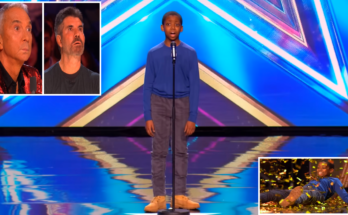
Twenty-eight-year-old Mickey Callisto arrived on the Britain’s Got Talent stage carrying a mix of quiet determination and a very human set of dreams. Hailing from Sunderland, he spoke plainly about two ambitions: the kind of lofty goal many singers whisper to themselves—one day performing at Wembley Stadium—and a far more immediate, tender wish. If he won the prize money, the first thing he promised to do was buy a stairlift for his grandmother, who badly needed one. That small, concrete detail—so practical and rooted in family care—did more than tug at the heartstrings; it made the audience lean in. Right away, Mickey seemed less like a contestant and more like someone the country could root for.
When he took to the stage, there was an easy warmth in his smile and a nervous energy he channeled into his presence rather than letting it fumble his focus. His song choice was bold and emotional: Queen’s “Who Wants to Live Forever,” a majestic ballad that requires not just technical skill but a deep sense of drama and vulnerability. From the first sustained note, it was clear Mickey had taken that on. His voice opened with a clarity and strength that filled the auditorium, drawing gasps and immediate applause. There was a resonance—an ability to hit the peak of the melody with power but also to pull back and let the softer moments breathe. It’s a rare combination that made his interpretation feel both authentic and reverent.
As he settled into the song, you could see why comparisons to Freddie Mercury began to surface. It wasn’t a caricature; it was a respectful echo of the original’s theatricality and emotional truth. Mickey didn’t try to mimic Freddie’s showmanship with grand gestures. Instead, he absorbed the spirit of the song—its longing, its existential questioning—and made it his own. He stretched the phrases when needed, held a note long enough for the emotion to land, and sculpted the dynamics so the quiet parts were as meaningful as the crescendos. At moments his voice brushed a gentle rasp, at others it soared clean and crystalline; that flexibility gave the performance texture and kept listeners engaged.
The audience reaction was immediate and visceral. People rose to their feet, not in a rote response to a familiar anthem, but because they had witnessed something stirring. There was cheering that felt spontaneous, as if the crowd were recognizing not just a great singer but a storyteller capable of making them feel. The camera cut to his family in the audience, and you could see their faces—pride, surprise, relief—expressing what words couldn’t. That juxtaposition of stadium-sized ambition and familial tenderness made the performance feel grounded and real.
On the judges’ panel, reactions ranged from stunned silence to open admiration. Bruno Tonioli, who had worked with legends and had a particular reverence for Freddie Mercury, was especially vocal. He praised Mickey’s performance with the kind of technical appreciation only someone intimately familiar with the original could offer, noting that Mickey had captured mannerisms and phrasing “down to a tee.” His comment that he could “listen to you all night” reflected genuine delight rather than flattery. Amanda Holden, always attentive to vocalists who bring spectacle and soul, called his voice “unbelievable,” a shorthand that nonetheless conveyed how overwhelmingly strong his delivery had been. Alesha Dixon labeled the whole performance “sensational,” pointing to both the vocal quality and the emotional pull. Even Simon Cowell—known for being exacting—recognized something ineffable: star power. He acknowledged that Mickey’s talent, paired with a warm personality, would make him memorable long after the audition lights dimmed.
One of the most striking things about Mickey’s performance was how seamlessly he balanced technique with feeling. He clearly understood the mechanics of singing: breath control, pitch, timing. But he also demonstrated an instinct for storytelling. When the lyrics asked, “Who wants to live forever?” Mickey didn’t present it as an abstract concept. He sang it like someone mulling over the fragile beauty of life, as if reflecting on the people he loved—his grandmother among them. That emotional tether gave the performance a sense of purpose beyond competition. It felt like a gift to the people watching.
When the final note hung in the air and faded into ringing applause, there was a long moment of collective exhalation. The judges’ unanimous four “yeses” came as both validation and expectation—a green light, yes, but also an invitation to see how far he could go. For Mickey, the result wasn’t just a step toward a possible Wembley headline; it was a confirmation that his voice could move a room and that his humble, heartfelt goals were within reach. Walking off the stage, his expression captured a blend of disbelief and gratitude. He arrived with a stairlift plan for his grandmother and a Wembley dream in his pocket; he left with the knowledge that, for now, the world had heard him and wanted more.