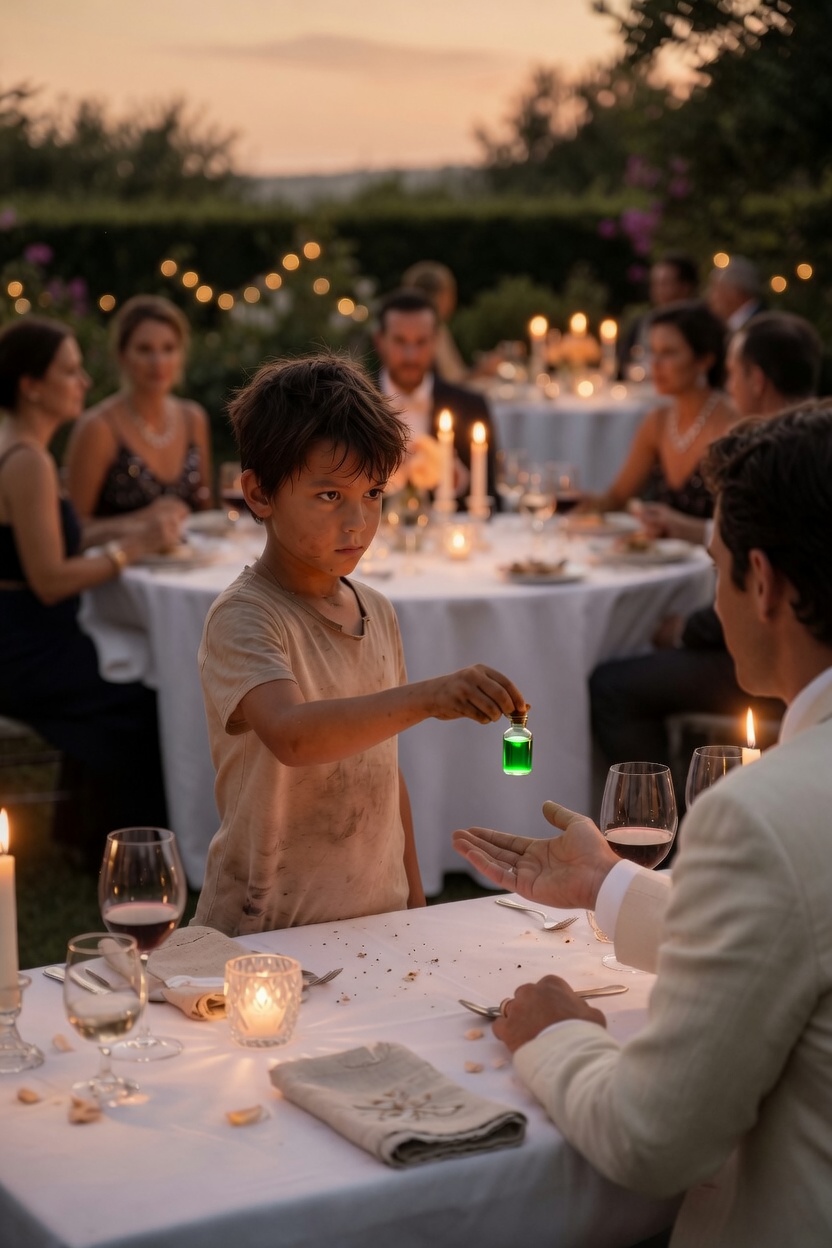
At first, the guests thought the boy was begging.
That was why no one reacted when he climbed the terrace steps—thin, ragged, barefoot, dragging a dirty sack that clinked softly with empty cans. In a place like that, children like him were supposed to remain invisible… unless security noticed them first.
Then he pointed straight at the millionaire’s table and shouted:
“Your daughter can see!”
The entire terrace shifted.
Forks froze halfway to mouths. A waiter stood motionless beside a bottle of wine. A woman near the railing turned so abruptly her chair scraped against the stone. Glasses clinked once—then silence swallowed everything.
The father didn’t stand up right away.
He froze mid-motion, one hand hovering near his plate, staring at the boy as if he had just heard something impossible… and yet strangely familiar.
Beside him, his daughter sat in a soft blue dress, dark sunglasses covering her eyes, a crutch resting across her lap like part of a story everyone had already accepted.
A few steps away, the wife in yellow stopped cold.
The boy lifted his sack higher.
“She poisoned her food.”
Now the father moved.
Slowly.
Too slowly.
He turned toward his wife, and the expression that crossed his face was worse than anger.
It was recognition.
The look of a man hearing a secret he had always feared… finally spoken out loud.
Then the little girl tilted her head toward the boy.
Not vaguely.
Not guessing.
Exactly.
The wife lost all color.
The boy dropped the sack onto the terrace floor, reached inside, and pulled out a small, unlabeled medicine bottle.
The father grabbed it—hard.
His hand trembled the moment he recognized it.
And into the silence, the little girl whispered:
“Mommy gives it to me…”
Somewhere behind them, a glass slipped from someone’s hand and shattered.
No one even flinched.
Then the boy said quietly:
“She told the nanny it works better in sweet juice.”
The wife spoke first.
Too fast.
“He’s lying.”
But her voice came out thin—already lifeless.
Because the father wasn’t looking at her anymore.
He was staring at the bottle… then at his daughter… then back at the boy—not like he was seeing a trespasser, but like he was looking at the first witness who had slipped through.
The terrace remained silent.
Even the wealthy guests stopped pretending not to listen.
The father crouched beside his daughter, his voice low and controlled.
“What does he mean?”
The little girl’s fingers tightened around her crutch.
The wife stepped forward. “She repeats things when she’s anxious—”
The father raised one hand without turning.
That was enough to silence her.
He looked at his daughter again.
“When does Mommy give it to you?”
The child’s lips trembled.
“In breakfast,” she whispered. “Sometimes in tea.”
The father went completely still.
The boy swallowed, forcing himself to continue.
“I sleep behind the restaurant,” he said. “Near the service gate. I heard her talking to the nanny. She said the drops make the girl sleepy… and keep her eyes unfocused.”
The wife closed her eyes for a moment.
Too long.
The father noticed.
The boy pointed at the bottle.
“She dropped that near the planters. She came back looking for it… wearing gloves.”
No one moved.
Then the father asked the one question he had been too afraid to ask—even himself.
“Can you see me?”
The little girl didn’t answer right away.
Then slowly…
She turned and looked directly at his face.
Not toward his voice.
At him.
The father’s expression collapsed into something empty and hollow.
The wife whispered, “Please…”
He stood up.
Very slowly.
And when he turned toward her, the fear on her face told everyone at that table the truth they already understood.
But the child said the worst part before either adult could speak.
“Mommy said I have to stay blind,” she whispered,
“until you sign the birthday papers.”
The father stared at her.
Because her birthday was next week.
And the trust amendment was scheduled… next week.
That was when it finally clicked.
The medicine was never meant to help the child.
It was meant to protect the lie.