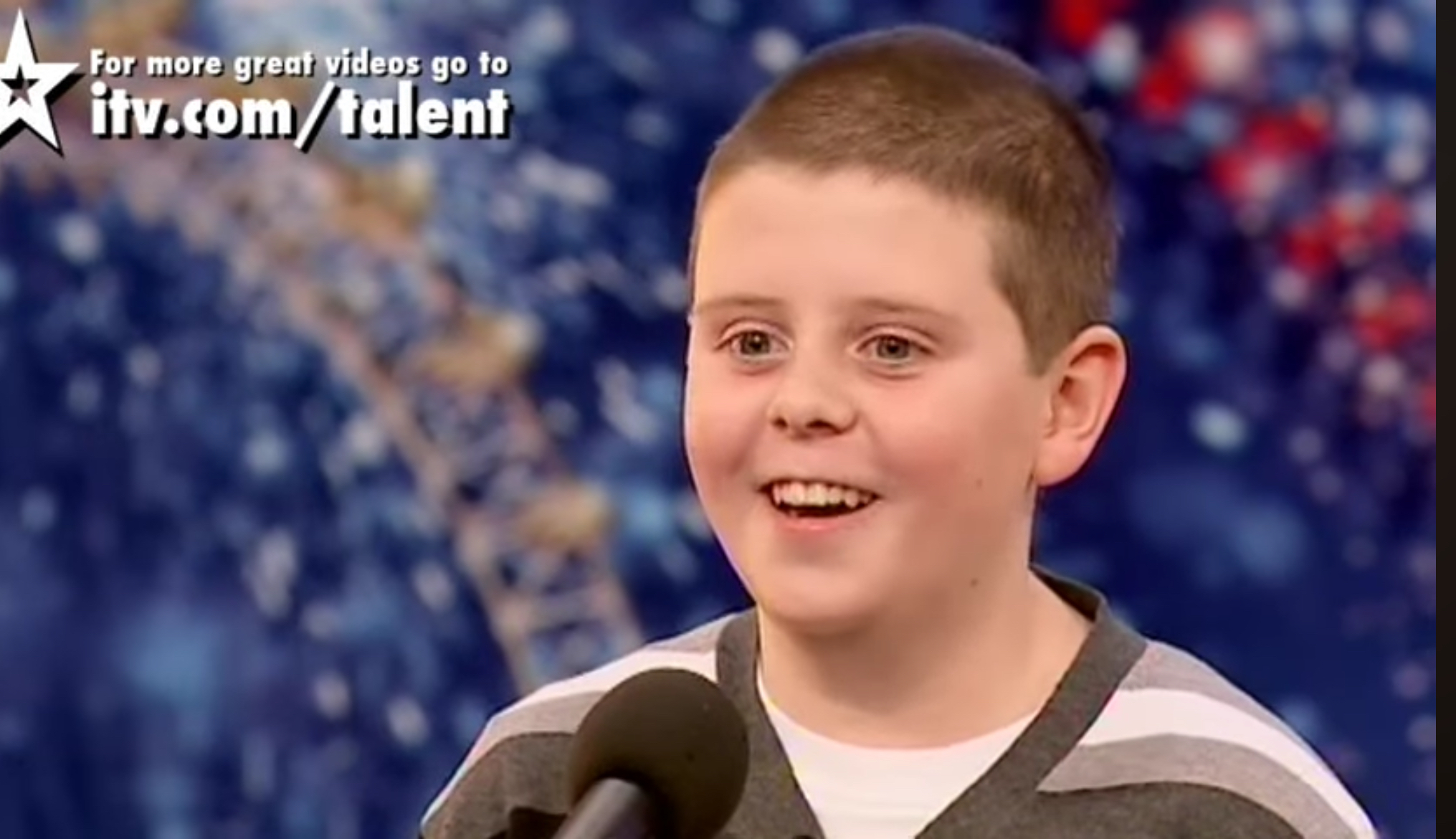
Fourteen-year-old Liam McNally arrived at the Britain’s Got Talent stage carrying a dream that felt both tender and monumental: he wanted, one day, to sing on the Royal Variety Performance. For Liam, singing wasn’t a pastime — it was woven into the fabric of his everyday life. He told the judges he woke up singing every morning, to the point that his grandmother used to complain, and you could picture those early mornings at home: a boy in his pajamas, voice filling the house while his family carried on with breakfast. With his nurse mother and newsagent father sitting in the audience, Liam admitted that their pride meant everything to him, but what he truly craved was confirmation from the judges — the kind of stamp of approval that might make his dream feel real.
When he stepped up to the microphone, there was a mixture of nerves and quiet confidence about him. He chose “Danny Boy,” a song that’s deceptively simple on the surface but demands emotional clarity and control to do it justice. From the first line, it was clear Liam had a respect for the song’s melancholy and tenderness. He didn’t rush; instead, he let phrases breathe, allowing the melody to unfold naturally. There was a purity to his tone — a bell-like quality that sat neatly above the accompaniment — but what set the performance apart was the way he invested each lyric with feeling. This wasn’t a teenager showing off vocal acrobatics; it was a young performer telling a story.
Small moments made the emotional pull stronger. Liam’s eyes glistened at the right beats, and there were micro-pauses where he seemed to listen to the audience as much as sing to them. His control over vibrato and dynamics was impressive: when the song demanded vulnerability, he softened and let the breath speak; when it called for intensity, he pushed forward without losing tonal beauty. The result was a performance that felt authentic rather than staged, the kind of delivery that leaves listeners leaning in rather than merely applauding technique.
The judges’ reactions came quickly and were immediate proof that Liam had struck a chord. Piers Morgan didn’t hold back; he called Liam a “serious contender to win Britain’s Got Talent,” a weighty compliment that suggested Liam’s audition had stakes beyond the moment. For Piers to say that so early in the competition was telling — it meant Liam carried something rare, an intangible quality that could sustain him through rounds to come.
Simon Cowell’s response mixed praise with a candid, bittersweet warning. He lauded Liam as a “fantastic singer,” highlighting the fire and raw emotion of the performance, but he also warned about the precariousness of adolescent voices. Simon advised that Liam’s current vocal power might only last “another six, nine months” before puberty altered his instrument. It was an oddly heartbreaking realism: the judge recognized the brilliance before him but also the inevitability of change. The warning landed with both tenderness and practicality — a reminder that even the most striking young talents are subject to time. Rather than diminish the praise, Simon’s comment added a layer of poignancy to the moment, underscoring how special and fleeting Liam’s current tone might be.
The applause that followed was warm and sustained, and when the judges pressed their buttons, the result was unanimous. Three emphatic “yeses” sent Liam through to the next round, and for a brief moment he looked like he might float off the stage. The expression on his face — stunned, smiling, breathless — captured the honesty of the experience. His parents’ faces in the crowd mirrored that pride: his mother’s eyes were wet with happiness, his father’s jaw relaxed into a proud grin. It was one of those small, human tableaux that make talent shows resonate beyond spectacle.
Beyond the immediate thrill of advancing, the audition felt like validation in the truest sense for Liam. He had stood before millions, presented a piece that required emotional maturity, and received not just technical praise but recognition for his ability to move people. Whether or not his voice changes in the months ahead, the performance confirmed something fundamental: he has a musical sensibility and an expressive heart that won’t vanish with a shift in vocal range. For now, the Royal Variety dream felt a little closer, and the judges’ words — both the glowing endorsements and the careful warning — became part of the next chapter in his musical journey.
Walking off the stage, Liam carried with him applause, advice, and a resonant quiet confidence. The moment had been both an arrival and a prompt: arrive at the next rehearsal, heed the guidance about care and technique, and keep singing every morning if that’s what makes the world feel right. Whatever the future holds, that audition would remain a bright, defining memory — the day a boy from New Moston turned waking-up songs into something the whole country could hear.


